How AI Is Transforming Clinical Decision-Making
The Data Explosion in Modern Medicine
Modern medicine is no longer limited by access to data.
Clinicians today are working with more inputs than ever before:
- Comprehensive lab panels
- Genomic and epigenetic data
- Patient history and lifestyle factors
- Wearables and longitudinal health tracking
On paper, this should lead to better care.
But in practice, it’s created a new problem:
Complexity.
Each data source provides valuable insight—but they exist in silos:
- Labs report values
- Genetic tests provide variants
- EMRs store history
What’s missing is a unified way to interpret all of it together.
And without that, more data doesn’t mean better decisions.
Why Clinicians Are Overwhelmed
The modern clinician isn’t struggling with access to information.
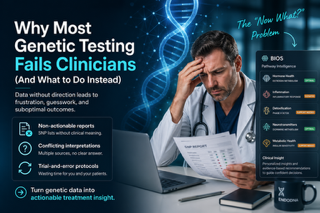
They’re struggling with what to do with it.
The Interpretation Burden
Every additional data source introduces:
- More variables to consider
- More potential interactions
- More uncertainty in decision-making
Instead of simplifying care, data often slows it down.
Time Constraints in Practice
In real-world settings:
- Appointments are time-limited
- Patients expect personalized answers
- Documentation requirements continue to grow
There isn’t time to manually:
- Cross-reference genetics with labs
- Map pathways across systems
- Build fully personalized protocols from scratch
The Burnout Reality
This combination leads to a familiar pattern:
- Cognitive overload
- Decision fatigue
- Reduced clinical efficiency
And ultimately:
Burnout.
Clinicians aren’t lacking expertise.
They’re lacking tools that match the complexity of modern medicine.
The Role of AI in Clinical Decision Support
AI is often misunderstood in healthcare.
The goal is not to replace clinicians.
It’s to support clinical reasoning.
What AI Should Do
The right kind of AI:
- Organizes complex data
- Identifies patterns across systems
- Surfaces relevant insights quickly
It acts as a decision support layer, not a decision-maker.
What AI Should Not Do
It should not:
- Replace clinical judgment
- Deliver black-box recommendations
- Remove the clinician from the process
In precision medicine, context matters too much for automation alone.
That’s why effective systems are designed to augment expertise—not override it.
As outlined in the BIOS framework, clinical AI must be structured, transparent, and aligned with real-world workflows—not generic or reactive
From Data Aggregation → Intelligence Layer
Most healthcare systems today are built for storage—not interpretation.
The Current Stack
- EMRs → Store patient data
- Labs → Deliver results
- Genetic tests → Provide variants
Each system does its job.
But none of them connect the dots.
The Missing Layer
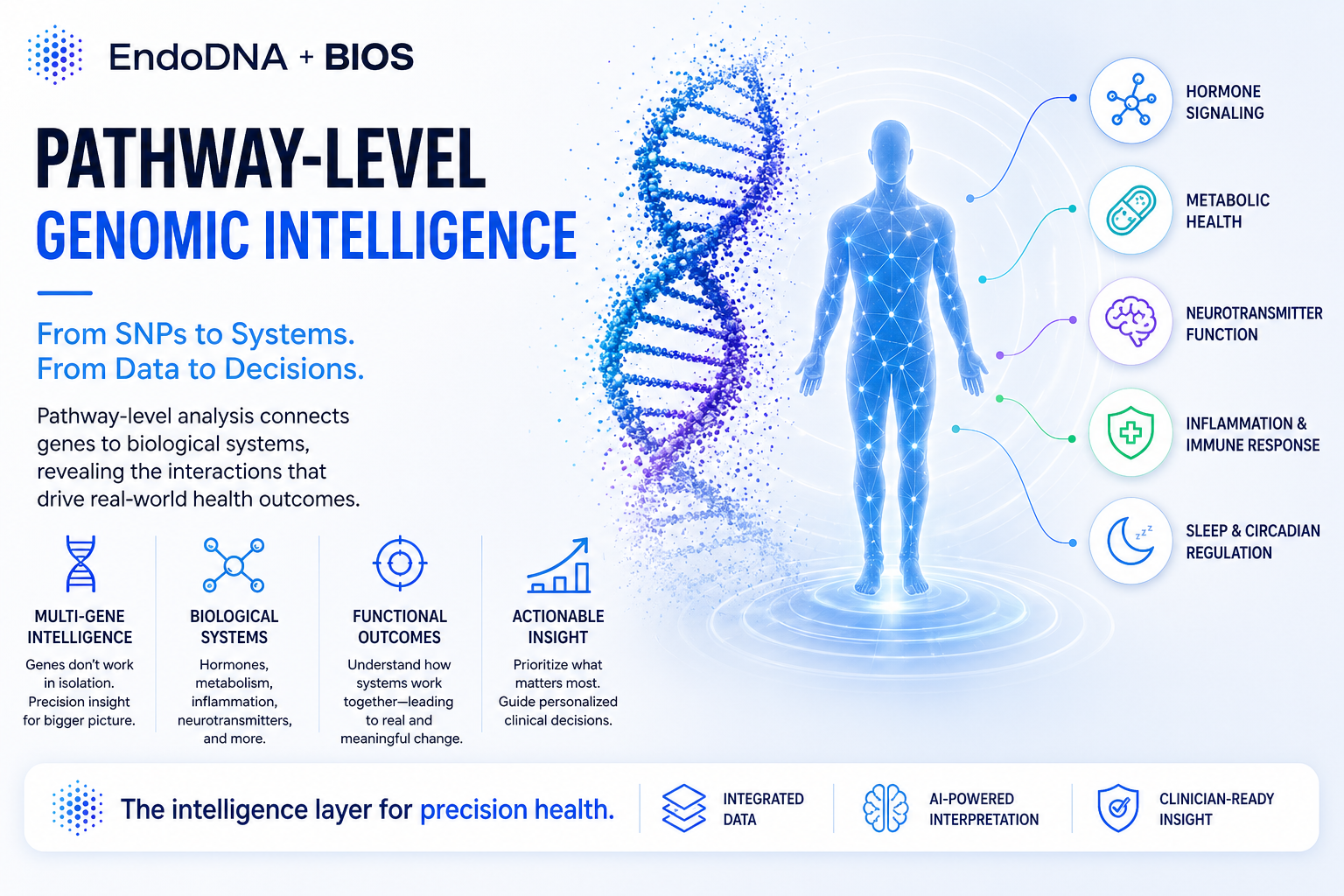
What’s needed is an intelligence layer that:
- Integrates multiple data sources
- Understands biological systems
- Translates complexity into action
This is where platforms like BIOS come in.
The BIOS Role
- EMRs store
- Labs report
- BIOS interprets
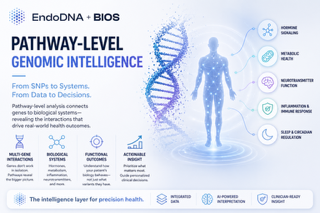
It connects genomics, biomarkers, and clinical context into a single, usable framework—transforming fragmented data into structured insight
Real-World Use Cases
AI-driven clinical decision support becomes most valuable when applied to real patient scenarios.
Drug-Gene Interactions
Understanding how a patient metabolizes medications:
- CYP450 pathways
- Pharmacogenomic responses
- Risk of reduced efficacy or adverse effects
This allows clinicians to:
- Select better medications
- Adjust dosing more precisely
- Reduce trial-and-error prescribing
Polypharmacy Risk
Many patients—especially in functional and longevity care—are taking:
- Multiple medications
- Supplements
- Hormone therapies
AI can:
- Identify interaction risks
- Highlight metabolic conflicts
- Surface safety concerns early
This is critical for patient safety and treatment optimization.
Treatment Personalization
By integrating genetics, labs, and symptoms, AI enables:
- More targeted protocols
- Faster decision-making
- Increased confidence in treatment plans
Instead of:
- Guessing and adjusting over time
Clinicians can:
- Start with a structured, personalized approach
Model-Agnostic, Future-Proof Intelligence
AI models are evolving rapidly:
- GPT-based systems
- Claude and other LLMs
- Domain-specific clinical models
But the real value isn’t in any single model.
It’s in the architecture around them.
What Future-Proof Systems Look Like
- Model-agnostic → Not tied to one AI provider
- Continuously learning → Improves with new data
- Clinically structured → Built for healthcare workflows
BIOS is designed with this in mind:
- It integrates evolving AI capabilities
- While maintaining structured clinical outputs
- And grounding insights in biological systems
This ensures the platform evolves as AI advances—without disrupting clinical use.
As demonstrated in the BIOS BRAIN architecture, true clinical AI requires memory, reasoning, and longitudinal context—not just one-time responses
Why This Matters for the Future of Care
Healthcare is moving toward:
- More data
- More personalization
- More complexity
Without better tools, this trajectory leads to:
- Slower care
- Increased burnout
- Reduced effectiveness
AI Changes That Equation
With the right implementation, AI enables:
Scale Without Burnout
- Faster interpretation
- Reduced cognitive load
- More patients treated effectively
Precision Without Complexity
- Structured insights instead of raw data
- Clear pathways instead of fragmented information
- Confident decisions instead of guesswork
The Bigger Shift
We’re moving from:
- Data-driven medicine
To:
Intelligence-driven care
Where clinicians are supported by systems that:
- Understand biology
- Learn from outcomes
- And help translate insight into action